

If you've spent any time around serious photographers, you've probably heard the phrase — "the holy trinity of lenses." It gets thrown around a lot, but what does it actually mean? And more importantly, should you build your kit around it?
This guide breaks down the lens trinity from top to bottom: what the three lenses are, why they matter, how they differ between full-frame and APS-C shooters, and what it really takes to shoot with them in the field.
What is the Holy Trinity of Lenses?
The holy trinity of lenses is a set of three zoom lenses that together cover virtually every focal length a working photographer needs — from ultra-wide to telephoto.
The standard full frame lens trinity consists of:
- 16–35mm f/2.8 — wide-angle for landscapes, architecture, environmental portraits, and tight interiors
- 24–70mm f/2.8 — standard zoom for portraits, events, editorial, and everyday shooting
- 70–200mm f/2.8 — telephoto for sports, wildlife, weddings, and compression effects
What ties them together isn't just the focal range. It's the consistent f/2.8 maximum aperture across all three lenses — giving you fast, reliable low-light performance and subject separation no matter which lens is on your camera.
The name itself is unofficial — a nickname that emerged organically in the photography community to describe lenses that feel indispensable. Some photographers jokingly call cheaper f/4 or kit-lens equivalents the "unholy trinity," which tells you something about how seriously people take the distinction.
Related post: Nikon Reveals Four New Lenses In Its Latest Roadmap
Why the f/2.8 Aperture Matters
The f/2.8 constant aperture is what separates the holy trinity from ordinary zoom kits. Here's why it makes a real difference:
Low-light performance. f/2.8 lets in twice as much light as f/4 — that's a full stop. In churches, concert venues, reception halls, or any situation where you can't control the light, that difference is the gap between a clean shot and a noisy one.
Consistent exposure across focal lengths. On variable aperture zooms (like 18–55mm f/3.5–5.6), your exposure shifts as you zoom in. With f/2.8 lenses, your settings stay the same from one end of the zoom range to the other.
Autofocus reliability in low light. Most camera systems rely on contrast or phase detection to focus — and both work better when more light is reaching the sensor. f/2.8 lenses typically autofocus faster and more confidently than slower alternatives.
Background separation. At 70–200mm and f/2.8, you get beautifully compressed backgrounds that isolate your subject. It's one of the reasons the 70–200 f/2.8 is the most-used lens at professional sporting events worldwide.

Full Frame Lens Trinity: The Classic Three
For full frame cameras — Sony a7-series, Canon EOS R5/R6, Nikon Z6/Z8, and their equivalents — the standard trinity is:
16–35mm f/2.8
The wide end of the trinity. Used by landscape photographers for sweeping vistas, by wedding photographers for dramatic church interiors, and by photojournalists for environmental context. The challenge with this lens is controlling distortion at 16mm — which is exactly why a stable, level tripod matters for serious architectural and landscape work.
Best for: Landscapes, architecture, real estate, environmental portraits, astrophotography
24–70mm f/2.8
The workhorse. If you could only own one lens from the trinity, most professional photographers would choose this one. It covers the natural field of view closest to human vision (around 45–50mm), making it feel intuitive and versatile for almost everything.
Best for: Portraits, events, weddings, street photography, product photography, editorial
70–200mm f/2.8
The reach lens. At 70–200mm on full frame, you can compress backgrounds dramatically, bring distant subjects close, and shoot in ways that shorter focal lengths simply can't replicate. It's the heaviest lens in the trinity — and often the one that benefits most from a good ball head or gimbal.
Best for: Sports, wildlife, weddings, birds, motorsports, telephoto portraits
APS-C Lens Trinity: A Different Set of Numbers
APS-C cameras — including entry-level and mid-range DSLRs and mirrorless bodies — have a 1.5x or 1.6x crop factor (depending on Canon vs. everyone else). This multiplies the effective focal length of every lens you put on them.
A 16–35mm on APS-C becomes roughly a 24–52mm or 26–56mm lens. That means the standard full frame trinity doesn't translate directly. You need different focal lengths to achieve the same coverage.
A practical APS-C lens trinity looks something like:
| Role | Full Frame | APS-C Equivalent |
|---|---|---|
| Wide-angle | 16–35mm f/2.8 | 10–18mm f/4 or 10–20mm f/2.8 |
| Standard zoom | 24–70mm f/2.8 | 17–55mm f/2.8 or 18–55mm f/2.8 |
| Telephoto | 70–200mm f/2.8 |
55–200mm or 70–300mm |
The tradeoff: fewer f/2.8 options exist for APS-C systems, and the ones that do exist are often less optically consistent than their full-frame counterparts.
The Prime Lens Alternative
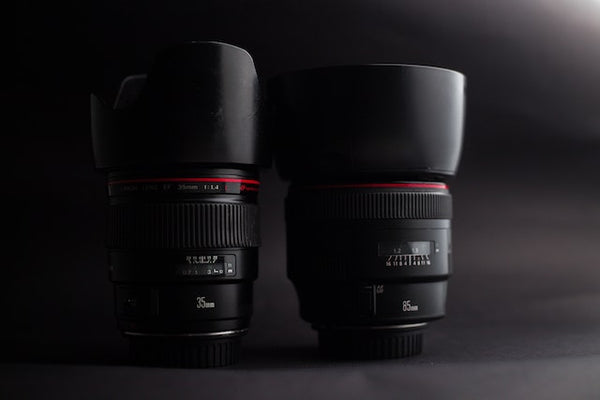
Some photographers build a similar coverage range using prime lenses instead of zooms — trading zoom versatility for optical sharpness and wider maximum apertures.
A typical "prime trinity" for full frame:
- 14mm or 20mm f/1.8–2.8 — ultra-wide
- 35mm or 50mm f/1.4–1.8 — standard
- 85mm or 135mm f/1.4–2.0 — short telephoto
Prime lenses have real advantages: they're often sharper wide open, lighter per focal length, and force you to be more intentional about your compositions. The downside is obvious — you swap lenses more often, which is slower and introduces more risk of dust and dirt on your sensor.
For studio shooters or photographers who work in controlled environments, the prime approach makes a lot of sense. For event photographers who need to adapt quickly, the zoom trinity wins on flexibility.
The Weight Problem Nobody Talks About
Here's the part most "best lenses" articles skip: the holy trinity of lenses is heavy.
A typical f/2.8 zoom runs 700g–1.1kg depending on the brand. Add all three lenses, a full frame body, and a vertical grip, and you're looking at 4–5kg of gear before you add a bag, straps, or any accessories.
That weight doesn't just affect your body over a long shoot — it affects your tripod stability, your ball head's precision, and your ability to hold a sharp shot handheld at slower shutter speeds.
If you're going to invest in a serious lens kit, the support gear that holds it steady deserves the same level of thought. A ball head that can barely handle 5kg won't track a moving bird cleanly. A tripod that flexes in wind will cost you sharp shots no matter how good your glass is.
What PMG Users Shoot the Trinity With
Photographers who shoot with heavy zoom setups tend to gravitate toward a few specific support combinations from our lineup:
TR424L + BH1 — Our 4-section carbon fiber tripod paired with the BH1 ball head. The TR424L tripod handles loads well beyond the typical full frame zoom kit and folds down to a compact travel length. The BH1 gives you smooth, precise adjustments without the creep you get from undersized heads.
TR344LBL + GKJr. Katana Pro — For birders and wildlife photographers who shoot the 70–200mm f/2.8 often, the Katana Pro gimbal head is purpose-built for telephoto lenses. It balances the lens front-to-back and lets you track subjects fluidly — something a ball head struggles to do with 1kg+ of glass on the front.
GKJr. Katana Pro alone — Some photographers run a gimbal on a single carbon fiber leg (monopod configuration) for events and sports where a full tripod isn't practical. The Katana Pro works for this too.
Should You Build the Holy Trinity?
The case for building it:
- Complete coverage — one bag, every situation, no second-guessing which lens to grab
- Consistent quality — no mismatches between your expensive 24–70 and a budget telephoto
- Resale value — f/2.8 pro zooms hold their value better than most photography gear
- Professional credibility — when you're hired to shoot events or weddings, clients notice the lens you're carrying
The case against:
- Cost — a full set of three f/2.8 zooms from a first-party manufacturer easily runs $6,000–$9,000+, more if you're shooting Sony G Master or Canon L series
- Weight — see above; this is a real concern for photographers who walk long distances or travel frequently
- Overkill for beginners — until your technique catches up to your gear, there's diminishing return on the upgrade
The honest answer: the holy trinity is worth building toward, not necessarily buying all at once. Most photographers who complete the set start with the 24–70 f/2.8 (the most versatile), add the 70–200 next, and fill in the 16–35 last.

Final Thoughts
The holy trinity of lenses has earned its reputation. These three zooms cover virtually every photographic situation with professional-grade performance — and the f/2.8 aperture keeps you consistent across the focal range in ways that variable aperture zooms can't match.
But glass alone doesn't make sharp images. The best 70–200mm f/2.8 in the world still needs a stable platform to perform at its peak. If you're building or completing a trinity kit, take a look at what's holding it up — a support system that matches your investment is what turns great glass into great images.